

Florida's Public Schools: Your Local Psychometric Research Facility

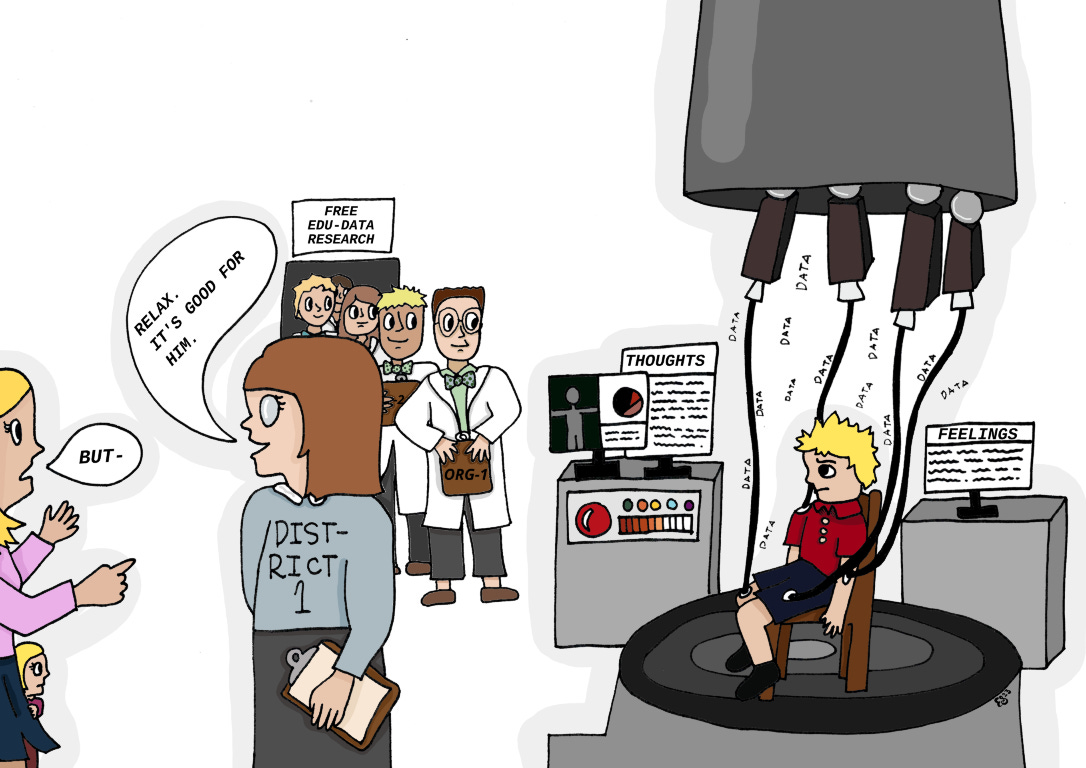
My last two posts covered how many kinds of surveys Florida distributes to students, as well as the alarming survey questions about drug use, guns, arrests, parents, friends, and more. In addition, Florida’s invasive surveys might undermine parental rights and the privacy of Florida’s students. Schools are not mental health care facilities! These surveys are totally inappropriate for distribution in schools.
Data Sharing and Use
The April 2023 FLDOE letter to school superintendents references Florida statutes, explaining that the new Florida Specific Youth Survey results “...will be used to inform the required instruction being provided in the school system, including instruction on Health Education as outlined in section 1003.42(2)(n), Florida Statutes,…”

How is “conservation of natural resources” an outline of “health education”?
The FLDOE stated they will use survey results to “inform...instruction” (i.e. determine what they teach). Yet, the surveys are only a sample, as described in the letter:
“Not all school districts are included in the sample and not all high schools in selected school districts will be surveyed.”
If they are applying results from a limited or “selected” population to other populations not surveyed, will those conclusions be representative of the whole student population receiving instruction?
According to whom and supported by what statistical analysis?
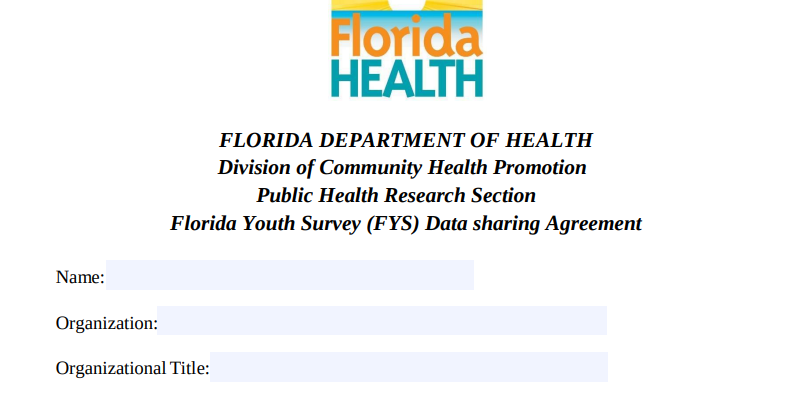
It appears survey data could also be used in research projects. Here is a data sharing agreement from 2018 posted by Florida’s Department of Health. Let’s hope “organizations” properly “delete” the data when they are finished, properly secure it while holding it, and do not attempt to re-identify the data. It is not clear whether the state has any procedures for performing security or compliance checks on the servers, the computers, or the software that “organizations” use to analyze student data. Is compliance with laws and agreements based only on trust?
Parental Rights
Outside of the use of psychological surveys in public education, data collection by the state and for-profit companies occurs almost everywhere in schools without prior written parental consent, a requirement of the Family Educational Rights and Privacy Act (FERPA) when it was passed in 1974. Duval County Schools explains how they will administer surveys without written consent:
“Students...will be sent home with a Parent Notification Form...informing you of your option to opt your child out of this survey. If you do not want your child to participate, please complete the form and return it to your child’s 2nd period teacher. “Note that this form constitutes passive consent – if no form is returned, it is assumed that the student has permission to participate.”
“Passive consent” is not prior written parental consent. If the form wasn’t sent home, didn’t make it home, or parents for any reason didn’t receive the form, then the school district assumes a parent consented, even though they did not. This should not be permitted:
“Students...will be sent home with a Parent Notification Form”
The Protection of Pupil Rights Amendment (PPRA), another federal law, requires “direct notification” about surveys asking questions concerning protected topics. Florida’s surveys cover more than one of the PPRA protected topics. Does sending a form home with a minor child constitute “direct notification”?
An FAQ at the Student Privacy Compass states: “PPRA notice must be direct (delivered by email, postal mail, or by hand).”
Ultimately, parents are not always informed and might have no idea invasive surveys are distributed to their children. This is the kind of abuse that occurs with opt outs rather than opt ins. Parents are totally reliant on schools to notify, and that does not always happen. A parent’s desire to protect and shield children from detrimental topics in such an explicit way should not be undermined by a state that purports to protect parental rights.
Privacy
The state surveys claim claim to be “private” and “confidential”, but are they really? How would you know? I suppose they want us to trust our government! Once data (thoughts and feelings) from your child’s mind are captured and digitized, who knows how it will be used, abused, or if it will be hacked.
The Substance Abuse Surveys state:“Your answers to these questions will be confidential. That means no one will know your answers.”
The Tobacco survey states:“The answers you give will be kept private. No one will know what you write.”
They don’t claim to be anonymous. They write “confidential” and “private”, not anonymous. Then the surveys go on to describe something more in line with anonymity: “...no one will know your answers”. Confidential and anonymous do NOT have the same meaning. It feels like they are conflating the meaning of confidential with anonymity. Are they misleading parents and children?
Does the state retain a link to personal identity?
Is it possible to identify students with demographic and other personal data points collected in surveys? Personal data such as age, grade, race, ethnicity, language spoken at home, grades, number of absences, and in the Substance Abuse Survey:
“Do you have a parent, stepparent, or guardian who is currently serving in a branch of the U.S. military (Army, Navy, Marines, Air Force, Space Force, Coast Guard, National Guard, or Reserves)?”
“Have you ever lived with someone who got sent to jail or prison?”
AI, advanced algorithms, and integrated databases are powerful. We are reaching a point where anonymity is a fleeting concept, and it only takes a few—often seemingly innocuous—data points to identify an individual.
Does sample size matter? I am not a statistician, but it makes sense that outliers in a smaller data set might be at risk of identification, especially when sharing data with data sharing agreements. As I mentioned earlier, the Florida Department of Education explained they limit sample sizes in their April 17, 2023 letter: “...not all high schools in selected school districts will be surveyed.” Are their sample sizes big enough?
This study points out that datasets as large as country-scale size don’t always do the job of providing anonymity. Their summary states:
“Although anonymous data are not considered personal data, recent research has shown how individuals can often be re-identified. Scholars have argued that previous findings apply only to small-scale datasets and that privacy is preserved in large-scale datasets…Taken together, our results show how the privacy of individuals is very unlikely to be preserved even in country-scale location datasets.”
In 2019 TechCrunch discussed several more studies on this topic in an article titled “Researchers spotlight the lie of ‘anonymous’ data”:
“It’s of course by no means the first time data anonymization has been shown to be reversible. One of the researchers behind the paper, Imperial College’s Yves-Alexandre de Montjoye, has demonstrated in previous studies looking at credit card metadata that just four random pieces of information were enough to re-identify 90% of the shoppers as unique individuals, for example.”
While the datasets in these surveys collect different kinds of information than in the studies, it seems possible data collected in Florida Student Surveys are identifiable. Parents should be wary of the long term privacy of these surveys.
Fooling Children
While scanning the 2023 surveys posted on Duval County Schools website, I came across a drug I had never heard of: Derbisol. That is because it is not a drug. It is a fictitious drug added into surveys to fool kids who are lying. Are schools in the business of trying to fool kids?
I found this 2017 study on the Washington (D.C.) Statistical Society website. The study was performed by ICF International, “ICF is a global advisory and technology services provider”, to test the feasibility of online Florida student surveys. It also concluded that Derbisol was still a “good validity check.” I suppose that means enough kids were fooled.
Fooling Teachers
The ICF report neglected to mention any analysis of real risks to security or privacy of online surveys.
Teachers were asked “Do you believe that student anonymity was maintained during the web administration?”.
Why were they asking teachers this question? Was it to measure trust and buy-in of the product whose instructions only claim answers are kept “confidential” and “private”, not anonymous!
Only 1% of teachers were concerned anonymity was not maintained, in both middle school and high school cohorts. Virtually all teachers “believed” anonymity was maintained.
Is perception more important than whether it actually protects anonymity?
Preservation of digital anonymity is not a question of belief. It is a question of outpacing malicious cyber actors, privacy policies, terms of use, laws, data and metadata collection, and more. The question “is anonymity preserved...” should have been posed to cybersecurity and privacy experts. Teachers are not privacy experts any more than they are mental health professionals!
In conclusion, surveys potentially increase the frequency of risky and detrimental behaviors and collect data the state has no business knowing. We cannot prevent the data from being used in research by “organizations”. There is no clear disclosure about how well data is protected from identification or re-identification, and the administration of surveys might violate parental rights. These surveys are not in the best interests of children.
Setting up systems susceptible to abuse (now or in the future) is never a good idea. Collecting sensitive data and storing it online is risky; student data is attractive to bad actors and cybersecurity is never fool-proof. Hence, there is a continuous stream of data breaches in the news regarding federal agencies, state and local governments, large and small corporations, and even educational institutions and their vendors.
Parents beware of data being collected on your children. You cannot predict with whom this data will be shared, or if it will be hacked, ransomed, leaked, or misused.