

You Asked Kids WHAT?!

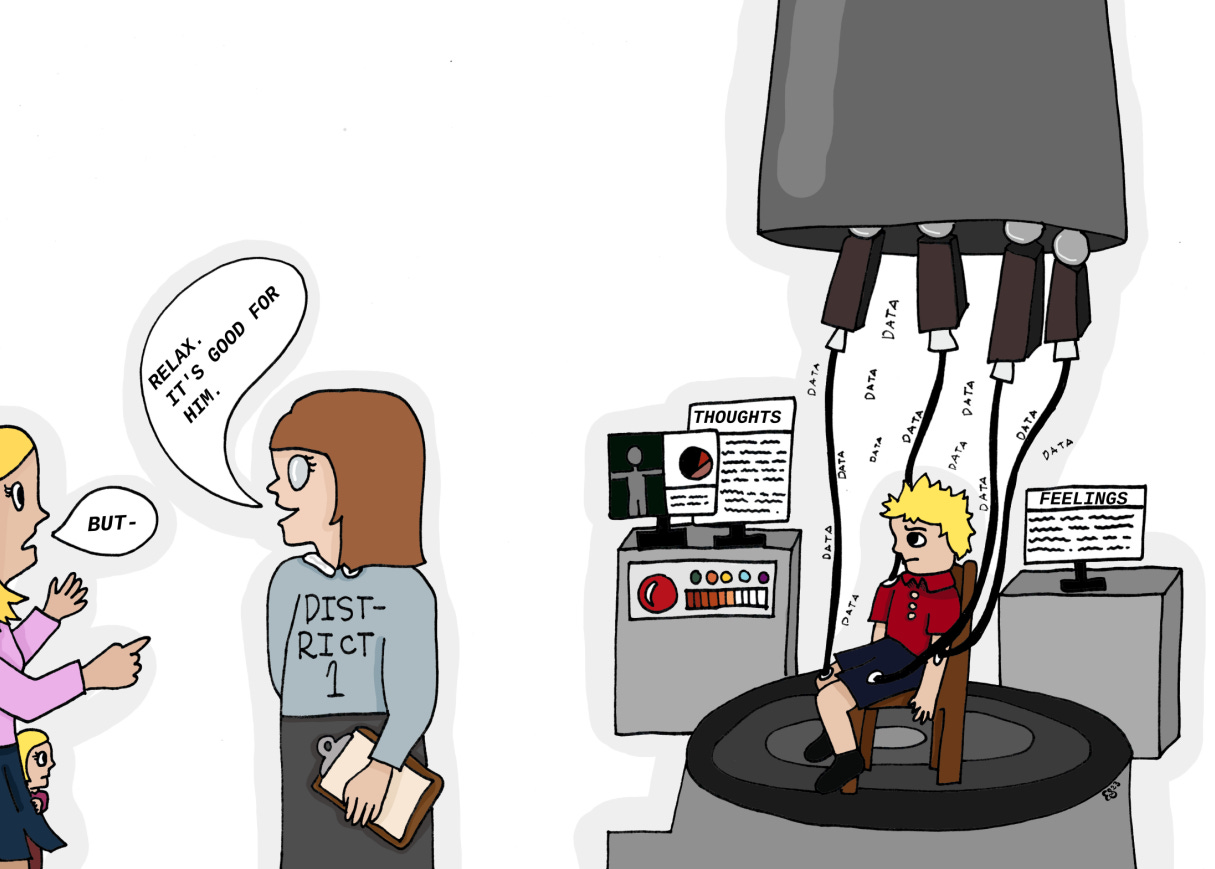
Among the problems in public education today are invasive surveys. Parents must remain vigilant—and sometimes need to possess omniscient powers—to stop invasive surveys before they are administered in classrooms. Surveys can appear unexpectedly as illustrated in last post's example of students who were reportedly surveyed on “How Puritan Are You?” in a history class.
Florida’s state surveys introduce topics and terms to innocent children. Aside from questions being wildly inappropriate, survey questions might increase the frequency of risky behavior, not be 100% private, make fools of children, pry into family life, and if administered with passive consent: violate parental rights.
After reading an April 2023 letter from the Florida Department of Education (FLDOE) to school superintendents that described the Florida Youth Survey, I wanted to know what questions are in the singularly-named “Florida Youth Survey” surveys. Yet, the only current source for surveys found was Duval County Public Schools. The Florida Department of Education did not respond to my questions.
Transparency Denied
There appears to be four different Florida school-administered youth surveys included in the Florida Youth Survey, as defined in the FLDOE letter. The number of surveys climbs to five if you include the Middle School Health Behavior Survey (MSHBS), another survey listed on the Florida Department of Health (FLDOH) website. At the time of this post, the FLDOE letter and FLDOH’s website define the Florida Youth Survey differently.
the new Florida Specific Youth Survey (grades 9-12),
Florida Youth Substance Abuse Survey (grades 6-8),
Florida Youth Substance Abuse Survey (grades 9-12),
Florida Youth Tobacco Survey (grades 6-12).
Middle School Health Behavior Survey (grades 6-8).
The Florida Department of Health apparently removed the official surveys from their website. Links that formerly led to surveys were removed: here (YRBS), here (MSHBS), here (FYTS), and here (FYTS). There is an archived version on the Wayback Machine from 2021 for the following Florida surveys under “Questionnaires”: YRBS, MSHBS (a survey not mentioned in the FLDOE letter), and FYTS.
The FLDOE administers these youth surveys but has little information about the surveys on their website, offering little more than a timeline to implement a new Social Emotional Learning (SEL) survey: the “Florida-Specific Youth Survey”.
Survey Questions
The surveys posted on the Duval County Schools’ website contain very intrusive questions. The Substance Abuse Survey covers many private topics: child mindsets, family arguments, guns, arrests, abuse, and drug use. They even ask children about their parents, including parent demographics and mindsets about illegal substance use:
Here are a few of the demographic inquiries about parents:
“What is the highest level of schooling your mother completed?”
“What is the highest level of schooling your father completed?”
“Do you have a parent, stepparent, or guardian who is currently serving in a branch of the U.S. military…?”
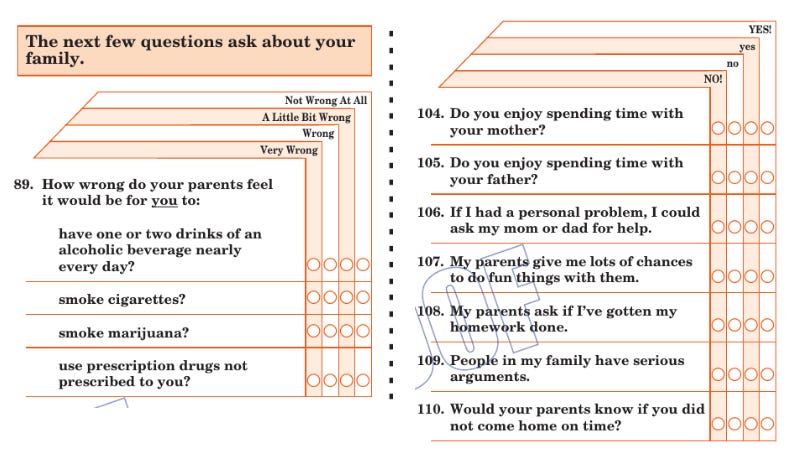
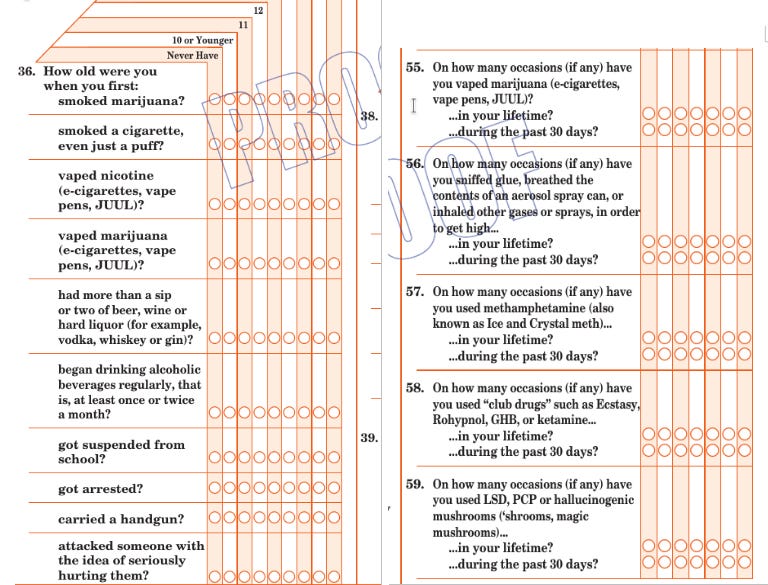
There are questions about use of cocaine or “crack”, Crystal meth, Ecstasy, LSD and PCP, Vicodin, Percocet, heroin, Ritalin, sleep habits, beating people up, taunting people, instant messages, how often the child has attempted suicide, considered suicide, committed theft, carried a handgun, sold drugs, etc.
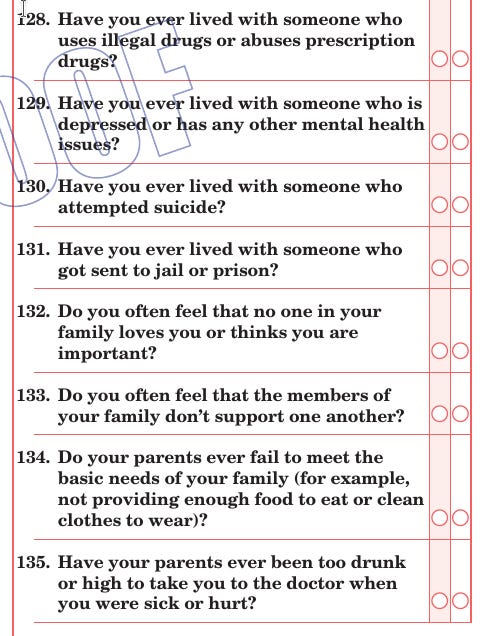
Below is an excerpt from the high school version of the Substance Abuse Survey. It includes questions about family and home life, such as: “Have you ever lived with someone who got sent to jail or prison?”
And here are a few more questions that normalize reporting on friends:
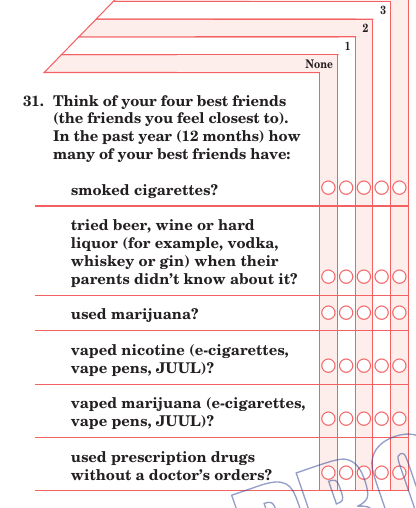
I discussed my concerns about Florida’s Resiliency Education and the new Florida Specific Youth Survey (FSYS) here. The FSYS survey includes questions such as: “I think negatively about myself.”, “I lose my temper.”, “I tell lies.”.
Many questions in these Florida youth surveys address the student’s emotional state and mindset—this is essentially psychological profiling.
The surveys are inappropriate for administration by a PUBLIC EDUCATION system; schools are not mental health facilities.
Many former U.S. Senators agreed. Here is what Senator Goldwater said back in 1974:
“Mr. President, our public schools have no compelling need for psychological and personality tests which pry into the private lives of a captive audience of school children.”
“Questions of this kind are an intolerable invasion of privacy. They exemplify the ever-watchful eye of ‘Big Brother’ spying into the most personal thoughts and habits of American families…”
“It is for us today to determine just how much freedom shall remain for the individual in the future. I implore my colleagues to vote for the Parental and Student Rights Amendment.”
Thus, the Family Educational Rights and Privacy Act was passed in 1974. Despite protections originally created under FERPA, children are now, once again, inundated with data collection without parent consent.
The Power of Suggestion
Thankfully, this year the Florida Department of Education put an end to the CDC’s Risky Behavior Surveys (YBRS). Florida’s Commissioner of Education, Manny Diaz, noted here what many already knew:
“The CDC asks leading questions … that may actually introduce risky behaviors to students, prompting them to engage in potentially detrimental activities,”
Here is what I wrote in 2021 regarding this CDC survey:
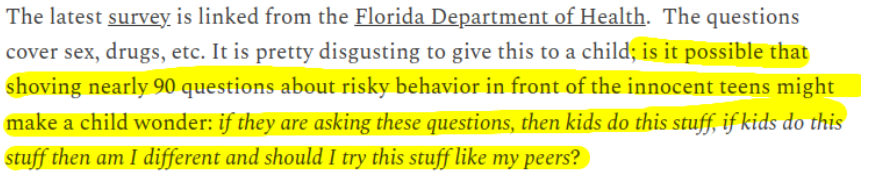
A paper posted on the National Institute of Health (NIH) website, originally published in 2008, is titled “Should we ask our Children about Sex, Drugs and Rock & Roll?: Potentially Harmful Effects of Asking Questions About Risky Behaviors”.
The authors explained how risky behavior surveys can be “quite dangerous”:
“...research on the question-behavior effect suggests that asking adolescents about risky behaviors has the potential to increase the frequency with which they engage in these behaviors. We argue that the act of screening or measuring risky behavior is potentially counterproductive.”,
and “surveillance surveys have a potential downside risk which is quite dangerous if not followed up by more thorough interventions.” [emphasis added]
But if risky behavior surveys can have a “quite dangerous” downside risk without interventions, why do Florida surveys state: “no one will know your answers”? How could the state possibly perform interventions without knowing who said what? It seems possible Florida’s administration of these surveys is creating worse, or more dangerous, outcomes for some children.
Despite potential detrimental risks, the Florida Department of Education continues to administer “school-based” surveys that include inquiries about suicide, drug use, illegal activities (examples noted above). Florida’s newest survey measures children’s mindsets, including emotions such as empathy—these are not questions that should be asked in a school.
Commissioner Diaz’s criticism that “leading questions … may actually introduce risky behaviors to students” applies to Florida surveys on suicide, substance abuse, tobacco use, and mental health just as it does to risky behaviors in the CDC survey.
The removal of the CDC survey did not end survey questions about suicide or detrimental behaviors. These questions can still be found in the Middle School and High School Substance Abuse Surveys, and in the Florida Specific Youth Survey.
In the survey below, they ask if a child has attempted suicide 6 or more times in the past 12 months. What message might this convey to a child? This is horrifying! Could this possibly increase suicide attempts among children? Lead a child to believe that suicide is normal to attempt? Might a child think this means attempted suicide does not result in death?
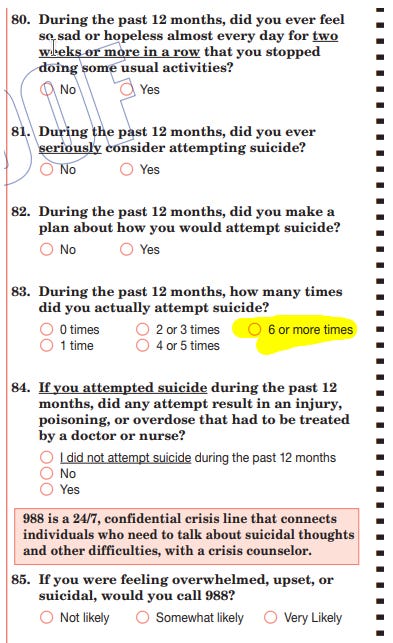
Florida’s surveys present inappropriate topics to children that risk increasing detrimental behaviors, and the Florida Department of Education clutched pearls over the CDC survey’s risky behavior questions—then surveyed students on some of those same topics in Florida’s surveys.
Check out my next post where I will share my concerns about survey data sharing, parental rights, and the privacy of surveys.